
How a financial institution approaches its marketing can not only help foster engagement and loyalty; it can also provide unique competitive differentiation. According to 2025 industry data, 71% of consumers think financial institutions should support the local communities they are a part of. But what does that local support look like, and what will consumers respond to?
To better understand consumer sentiment toward local marketing from banks and credit unions, Vericast surveyed 1,000 U.S. adults in Q4 2025. The data reflects potential behavioral trends banks and credit unions can use to help inform how they engage communities. The U.S. Consumer Hyper-Local Engagement Survey analyzes generational differences and preferences, what builds trust with FIs, and what gives FIs a competitive edge today.
How Consumers Engage Locally is Shaped by Generational Differences
Survey respondents were asked if, in the last six months, they noticed advertising or marketing that referenced their local community at all. Local FIs seemed to catch a bit more attention from older demographics on this front while large, national banks reached younger age groups.
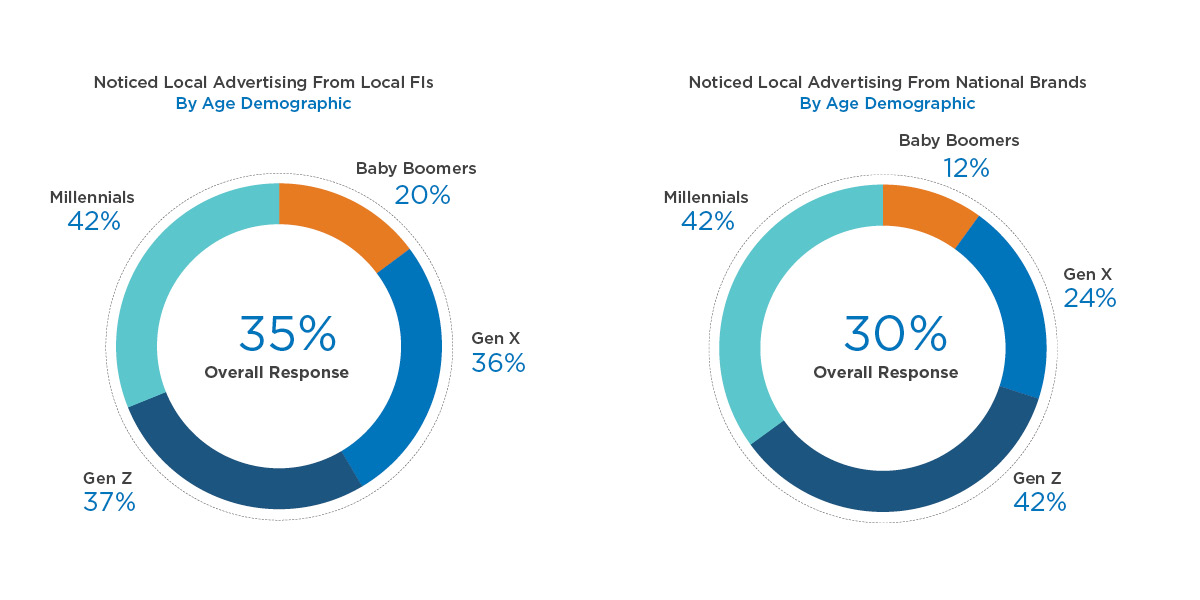
Based on these data, younger consumers appear far more likely overall to notice localized advertising than older generations, showing that community-based content resonates well with Millennials and Gen Z. This could be linked to how and where banks and credit unions are focusing their marketing and advertising, from social media platforms to in-app ads to streaming services.
There could be a missed opportunity with Baby Boomers as 57% of this respondent group noted not noticing any localized content over the last six months. Accordingly, it seems that national brands risk missing older audiences, or meaningful engagement with these groups if localization isn’t tailored to fit what matters to them or reach them where they are.
Consumers Increasingly View Bank and Credit Unions as Community Educators
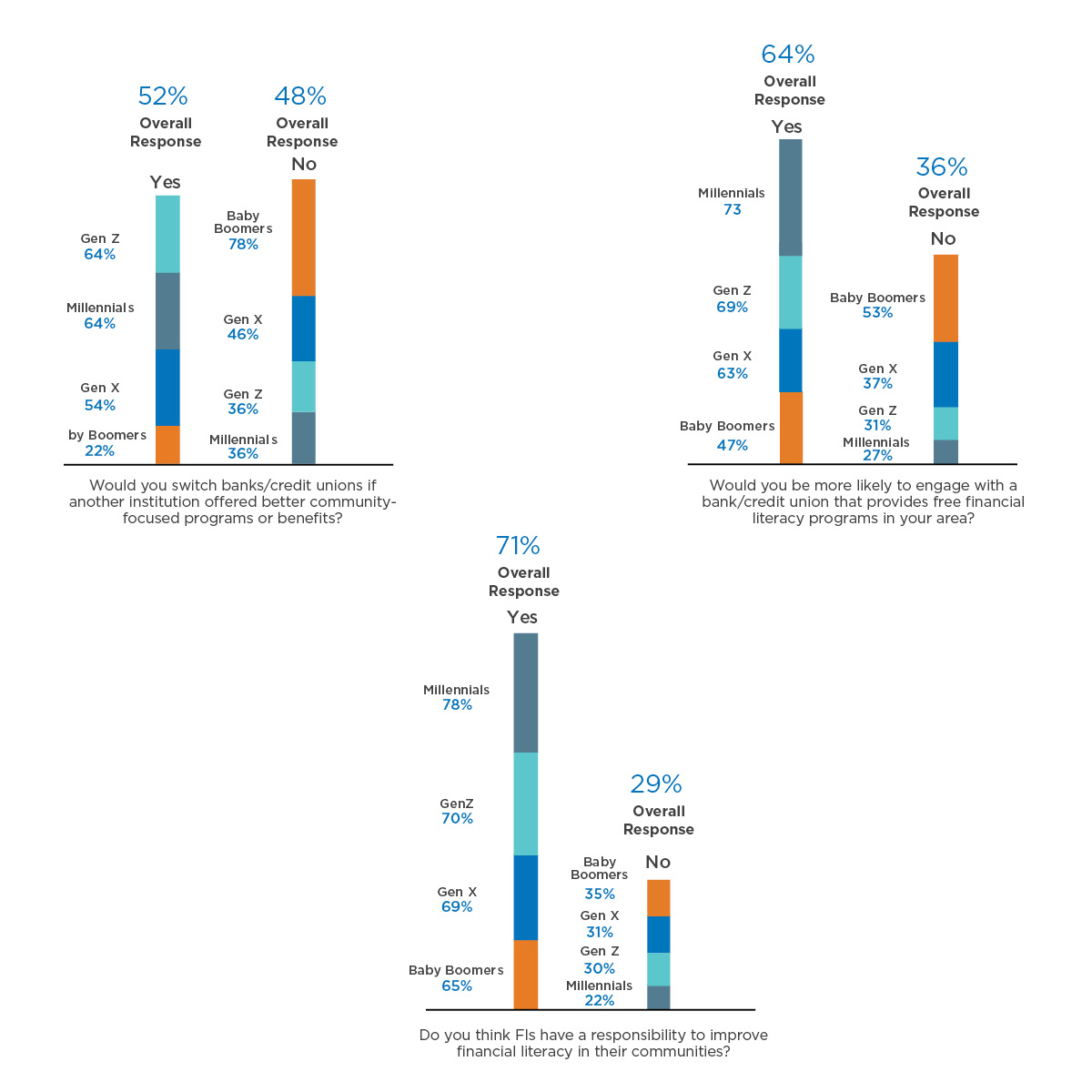
While FIs provide a service to customers, their approach to financial education and community investment may play a larger role in how consumers choose to engage. Our data indicates that consumers are looking for more than a place to keep their money and, even, that they are they’re looking for banks and credit unions to help financial knowledge and understanding in their communities.
Local Marketing Helps Build Trust and Drive Engagement
More than half of respondents (52%) say localized marketing that is relevant to their neighborhood or community would increase their likelihood of engaging with that bank or credit union. Marketing and advertising that reflect the local community also appear likely to get consumers to pay attention. In fact, 72% of respondents say they are somewhat to very likely to pay attention to marketing that highlights their local community. Further, 71% say they would be more interested in banking with an bank or credit union whose marketing reflected this.
When it comes to doing business with a brand that highlights their community, 43% of respondents are more likely to consider doing so. Nearly half of Millennials (49%) are in this camp, with 45% of Gen Z, 44% of Gen X, and 34% of Baby Boomers saying the same.
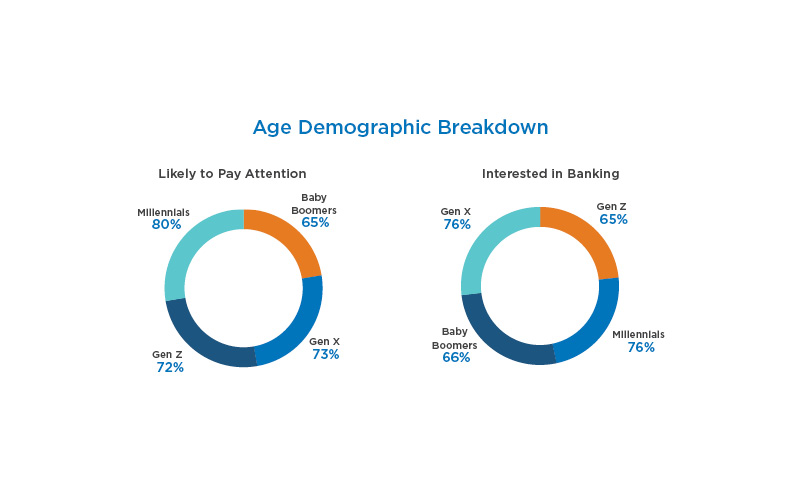
Consumers also appear to be more likely to trust financial advice or guidance from FIs that feel connected to their communities. Overall, 61% of respondents either agree or strongly agree with this statement. This is also true for 50% of Baby Boomers, 59% of Gen X, 69% of Millennials, and 62% of Gen Z.
Emotional Connection is the New Competitive Edge
Trust appears to be a critical basis for how consumers connect and engage with banks and credit unions. And localized marketing content seems to have a clear impact on how consumers perceive financial brands. For example, 1 in 3 respondents states that they are more likely to trust institutions that highlight their local community, and 37% say this approach improves their perception of that FI’s authenticity.
Local, community marketing may be correlated with elevating trust among Millennial and Gen Z consumers, with 45% and 43% of these respective respondent groups agreeing with this connection. It also seems to improve perception of authenticity across all age groups – 45% of Millennials, 38% of Gen Z, 34% of Gen X, and 31% of Baby Boomers agreeing with this connection.
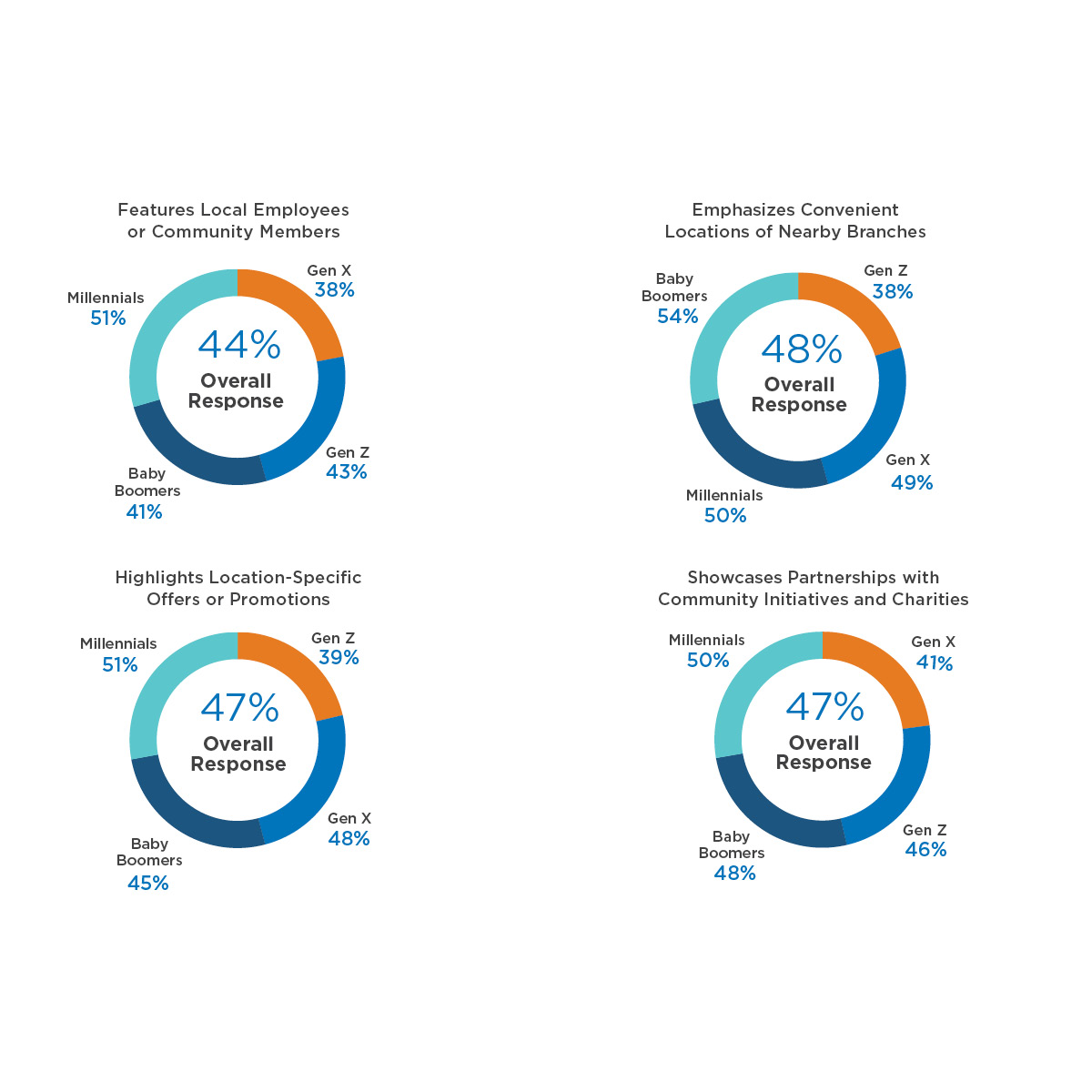
Diving deeper into authenticity, based on this survey data, there appear to be specific elements banks and credit unions can lean into that help make the message feel more genuine and appealing.
The Opportunity for Today’s Financial Institutions
Reaching consumers and earning their engagement, and ultimately their business may hinge on how much trust consumers have in a bank or credit union’s ability to provide what they need. Trust often begins at the local level, and local storytelling can help to build credibility for banks and credit unions. Awareness seems to be a real factor too, with 64% of respondents being able to name at least one bank or credit union that has deployed local-specific marketing in their area.
Local relevance should become more important as awareness grows, helping to cut through advertising fatigue and garnering the right level of customer attention. Tangible community connections come across as the most authentic for consumers, and localized marketing is a stronger driver of engagement versus generic, national campaigns.
So, what can banks and credit unions at the local level in an effort an improve engagement? We recommend:
- Modernize local strategies with data that identifies where younger audiences are most responsive to enable precise, community-level activation across digital and physical channels.
- Turn trust into measurable growth by combining local data insights with creative that authentically reflects the community, translating credibility into new accounts and deeper engagement.
- Improve preference by leaning into more personalized offers and promotions, highlighting branch proximity, and showing continued investment in the local community with financial literacy programs.
As banks and credit unions look to convert awareness into preference and loyalty, we believe that it will be increasingly important to leverage marketing providers and solutions that can:
- Enable banks and credit unions to rise above digital noise, targeting consumers with messages that feel personal and local.
- Deliver data-backed recommendations to banks and credit unions so marketing collateral resonates and feels genuine.
- Help banks and credit unions optimize campaigns by zip code to maximize for engagement and ROI.
Proximity and authenticity appear to work together to build credibility and trust at the local level. Banks and credit unions must work to establish their brand as true community partners. Maintaining this approach through geo-targeted campaigns and personalized creative is essential to customer acquisition and long-term loyalty.
This post reflects consumer survey responses and general marketing observations. Results are not predictive and may vary across financial institutions, markets, and consumer segments. All marketing activities must be designed and executed in compliance with applicable laws, including privacy, advertising, fair lending rules and regulations.