
The next banking decision may not start with a rate sheet. For many consumers, it may also be shaped by the people they trust most. New Vericast data shows parents and family members often play a meaningful role in young adults’ financial decisions, even as conversations about money remain difficult for many households. For financial institutions (FI), that may create an opportunity to build trust earlier, communicate value more clearly and show up in ways that feel relevant to the broader decision-making circle around the consumer.
That influence extends beyond today’s banking decisions and is already shaping tomorrow’s consumer expectations. Younger generations are influencing household spending long before they manage their own accounts. eMarketer found that Gen Alpha drives nearly half (42%) of household purchases and commands up to $101 billion in direct purchasing power, according to parents. With parents playing a significant role in financial decisions and younger generations influencing household spending, FIs may need to rethink how they engage broader decision-making groups and whether their incentives are clear, relevant and compelling enough to support long-term retention.
In June 2026, Vericast surveyed 1,000 U.S. adults to understand how involved parents and guardians are in their young adults’ financial decisions. Survey respondents indicated that notable numbers of Gen Z received help from their family when choosing an FI, choosing a credit card or managing bills and debt, but the conversations often do not go much further. To support stronger relationships, institutions can focus on earning trust, communicating value and meeting rising expectations for family involvement.
Parental Guidance Goes Well Beyond the Age of 18
Many survey respondents reported relying on parents and family members for financial guidance, particularly among Gen Z and Millennial children. When asked what type of help Gen Z has received from family members around financial decision making, 31% of survey respondents said they had help choosing a bank, 29% with choosing a credit card, and 27% managing bills or debt. Millennials also received guidance on selecting a bank (21%), a credit card (21%), and managing debt (25%).
Despite 68% of those surveyed saying they are more involved in their children’s finances than their own parents were, respondents largely view family involvement as a positive. More than a third (36%) say family involvement leads to better financial decisions, while others point to additional benefits and potential drawbacks of making financial choices together.
- Improves Family Communication: Nearly one in three survey respondents (30%) see family involvement in finances as a way to improve overall trust and communication between parents and children.
- May Increase Family Tensions: At the same time, another 13% of respondents believe it can create conflict. This is especially true of older generations with nearly a quarter (19%) of Boomers believing family involvement in finances is a negative.
- Can Foster Overdependence: A small margin of respondents – 13% – think parental guidance leads to young adults being too financially dependent, with 15% of Gen X, the highest among generations, believing this.
- Parents are in the Know: Given the apparent influence of the older generation, it’s fortunate that, many survey respondents see parents’ guidance as credible when it comes to the latest trends, with 92% of respondents thinking younger generations will receive the most up to date information if parents are involved in the decision-making process related to finances.
Some survey respondents see potential downsides to familial involvement, but survey respondents generally viewed family involvement positively. For FIs, the relationship opportunity may extend beyond the individual account holder. Institutions have an opportunity to build trust across the broader decision-making circle by making financial information easier to understand, compare, and act on.
Financial Transparency is Growing – But Vulnerability Remains Difficult
Even though families are taking a more collaborative approach to managing finances, conversations about money are still one of the most difficult to have. More than half (66%) of survey respondents say they are open about finances with family, yet 39% also avoid discussing financial decisions with their families. Notably, 28% went as far as saying they’d rather eat a bug than talk to family about finances, underscoring how uncomfortable these conversations can feel for some respondents.
Comfort levels in these discussions tend to vary by generation.
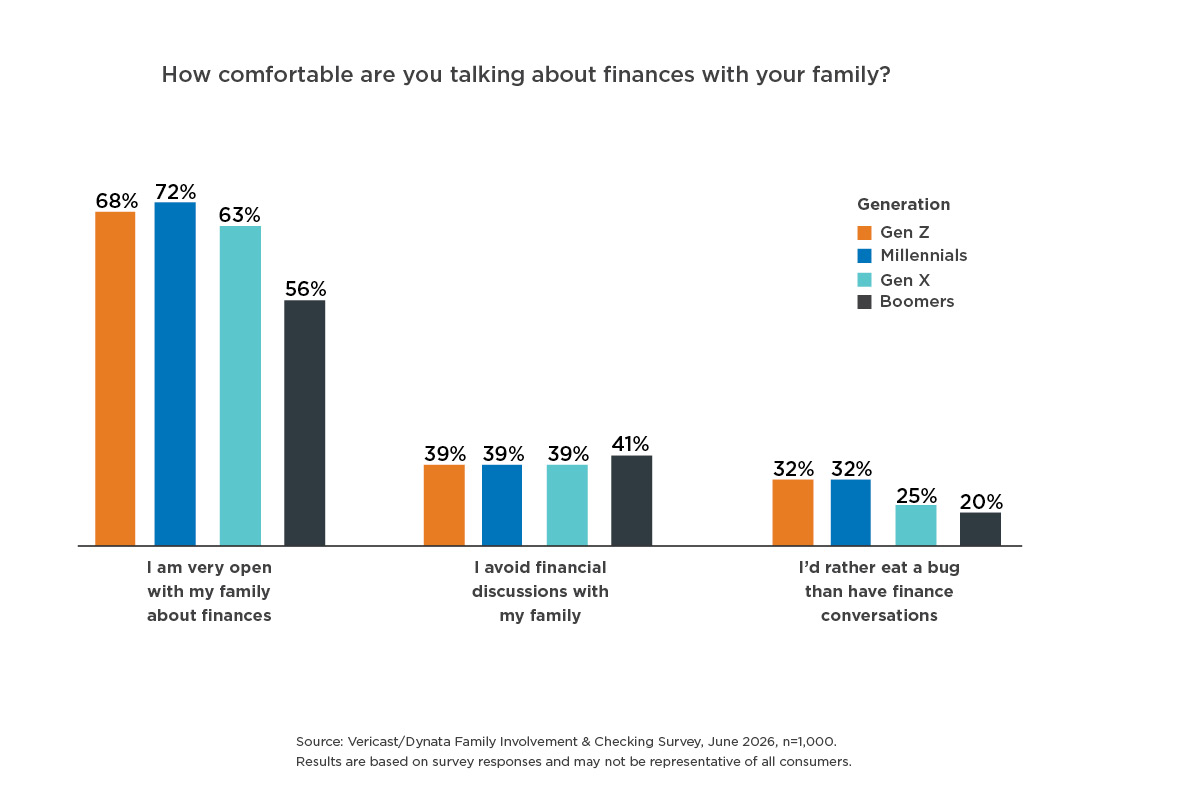
Financial conversations within families are becoming more comfortable, yet many still avoid them when they matter most. That creates an opportunity for FIs to serve as a trusted, neutral resource that helps families navigate financial decisions with clearer information and less friction. This matters because 15% of survey respondents said they would consider switching checking accounts if they received a recommendation from someone they trust.
The Path Forward: Building Trust Across the Decision-Making Circle
Knowing the primary customer isn’t always the only one making financial decisions anymore; FIs are presented with a new challenge: communicating value in ways that resonate with the broader decision-making circle while still supporting long-term customer relationships.
Our survey data shows that traditional marketing strategies built around a single audience may fall short when multiple family members influence the same financial decision. Even when one person is the primary account holder, FIs should consider how to communicate clearly with all those involved in the financial decision-making process in a way that builds visibility, trust and understanding across households.
Data Source: Vericast/Dynata Family Involvement & Checking Survey, June 2026, n=1,000. Percentages by generation are directional and subject to sample-size limitations. For this survey, the breakdown by generation is as follows: Born 1945 or earlier: 24, Baby Boomers (1946-1964): 193, Gen X (1965-1980): 265, Millennials (1981-1996): 326, Gen Z (1997-2012): 192.